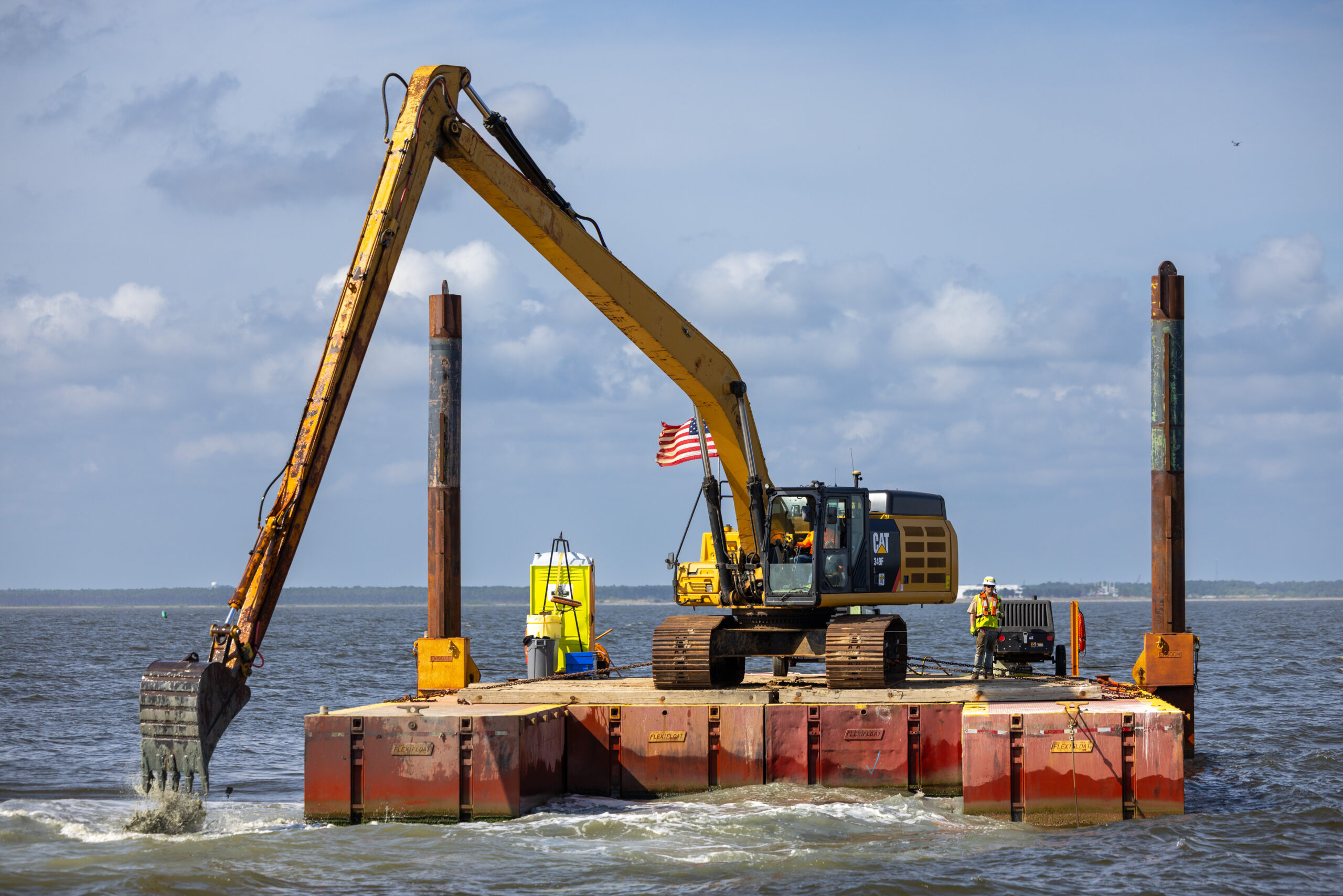
MOBILE COUNTY, Ala. – The Mobile County Commission announces that the Bayou La Batre Wastewater Outfall line project construction, which began in September 2024, was completed in July 2025. This critical infrastructure upgrade, funded by the RESTORE Act, will significantly improve water quality for residents in Bayou La Batre.
“I am thrilled to see this part of the project completed. The environmental testing and planning for this project started more than 10 years ago when I was the Director of the Marine Resources Division,” said Alabama Department of Conservation and Natural Resources Commissioner Chris Blankenship. “By extending the outfall line farther offshore, we’re improving water quality, supporting marine life, and reducing risk for the oyster aquaculture industry.”
An outfall line is a critical component of a wastewater system that safely transports treated wastewater to its discharge point. This initiative, administered by the Mobile County Commission on behalf of the Utilities Board of the City of Bayou La Batre, involved constructing a new wastewater outfall line to move the discharge location an additional four miles offshore. The improved mixing of freshwater from the outfall line with saltwater in the Mississippi Sound will strengthen oyster habitats.
“The successful completion of the Bayou La Batre Wastewater Outfall line means cleaner water, healthier seafood, and a boost to the quality of life for everyone who lives in the Bayou,” said District 3 Mobile County Commissioner Randall Dueitt. “This upgrade reinforces the Commission’s commitment to environmental stewardship and improving local quality of life.”
The outfall line project supports ongoing efforts to restore and protect water resources in the region, a priority for the Bayou La Batre community, which was heavily impacted by the 2010 Deepwater Horizon oil spill.
“It may have been a long time coming, but good things are worth waiting for,” said Bayou La Batre Mayor Henry Barnes. “This project is a big deal for Bayou La Batre. We’d like to thank Mobile County for helping to make it happen.”
The project was sponsored by the RESTORE Council in cooperation with the Alabama Department of Conservation and Natural Resources. It was paid for with federal funding from the RESTORE Council under the Resources and Ecosystems Sustainability, Tourist Opportunities, and Revived Economies of the Gulf Coast States Act of 2012 (RESTORE Act). The total contract cost for the Outfall Extension Project was approximately $16 million, with funding secured through the Gulf Coast Ecosystem Restoration Council.
ABOUT MOBILE COUNTY COMMISSION:
Commissioners: President Merceria Ludgood (District 1), Connie Hudson (District 2), and Randall Dueitt (District 3). As the governing body for Mobile County, Alabama, the Commission is responsible for budget and infrastructure decision-making that enhances quality of life and makes Mobile County a great place to live, work, play, and visit. Mobile County Commission maintains almost 1,400 miles of roads, 160 bridges, 100 buildings, and multiple parks, and provides funding for all County operations, including the Sheriff’s Department, Metro Jail, License Commissioner, Revenue Commissioner, and Probate Judge. The Commission is integral to economic development within the region and is committed to increasing public access to water through its Parks Initiative.
ABOUT MOBILE COUNTY, ALABAMA:
Established in 1812. Population: 411,640 (Census, 2023). Size: 1,233 square miles of land (962 unincorporated) and 412 square miles of water. Logistics highlights: Alabama State Port, Intersection of I-10 and I-65, Five Class 1 railroads, Two airports. Top industry clusters: Aviation/Aerospace, Chemical, Healthcare, IT/Tech, Logistics/Distribution, Maritime, Oil & Gas; Economic Development: from 2010 to 2024, about 14,500 new jobs were created (Mobile Chamber). Annual GDP: Third largest in Alabama, about $25 billion (bea.gov 2023). 11 Municipalities: Bayou La Batre, Chickasaw, Citronelle, Creola, Dauphin Island, Mobile (county seat), Mount Vernon, Prichard, Saraland, Satsuma, and Semmes.
PHOTO: Mobile County Commission