
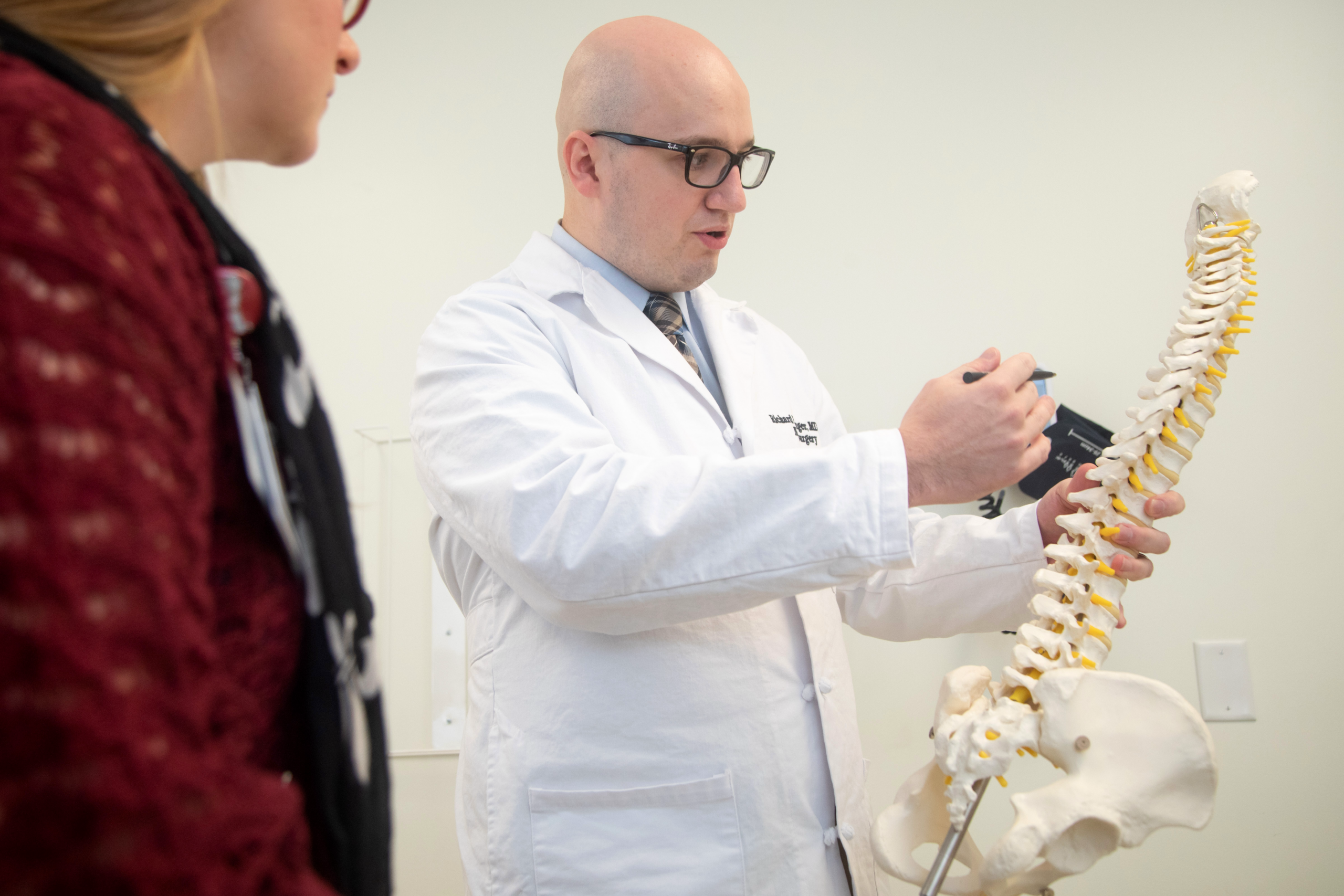
USA Health neurosurgeon presents spinal deformity program at University of South Florida grand rounds
MOBILE, Alabama (April 13, 2026) — Richard Menger, M.D., MPA, chief of complex spine surgery and vice chair of neurosurgery at USA Health, recently presented a virtual grand rounds lecture to the Department of Neurosurgery at the University of South Florida (USF) on developing a multidisciplinary framework for a spinal deformity program.
Titled “Crafting a Spinal Deformity Program: Strategy, Tactics and Failures,” the presentation highlighted the development of a comprehensive spinal deformity program and offered insights into building a high-performing, multidisciplinary care model.
During the lecture, Menger outlined key strategies for establishing a spinal deformity program, including aligning institutional resources, implementing strategic planning, and integrating multidisciplinary collaboration to optimize patient care. He also explored emerging technologies and patient care infrastructures that enhance surgical precision, reduce complications, and support consistent, reproducible outcomes. Additionally, he addressed the role of healthcare policy in shaping surgical practice and emphasized the importance of advocating for reimbursement and regulatory frameworks that support complex care delivery.
“We are proud of what we have accomplished here at USA Health and the University of South Alabama as a group working together,” said Menger, who also serves as an associate professor of neurosurgery at USA’s Frederick P. Whiddon College of Medicine. “We can provide that high level of interdisciplinary care that competes on a national level. Patients with complex spine problems who live on the Gulf Coast don’t have to travel to bigger cities or centers.”
Menger presented USA Health’s spinal deformity program as a real-world case study, demonstrating how a mid-sized academic health system can successfully build a high-volume center for complex spinal conditions. The program treats both pediatric and adult patients with some of the most advanced spinal pathologies, including scoliosis, severe deformities, and cases involving multiple prior surgeries.
The program was developed to address a significant gap in access to specialized care across the Gulf Coast region, where patients previously had to travel to cities such as New Orleans or Birmingham for advanced treatment. Today, the program enables patients to receive highly specialized care closer to home.
Menger’s presentation also covered both advanced surgical techniques, including freehand pedicle screw placement, patient-specific 3D implants, and complex osteotomies, or bone removal, and the broader systems-level approach required to support such procedures. He emphasized that successful outcomes rely not only on surgical expertise, but also on coordinated, team-based care models.
Since its establishment, the spinal deformity program at USA Health has significantly improved patient access by allowing complex cases to remain local. The program maintains a strong focus on outcomes tracking, case review, and continuous improvement, while positioning itself for continued growth in clinical volume, academic productivity, and national recognition.
Ryan Screven, M.D., a graduate of the Whiddon College of Medicine, currently serves as chief resident in the USF Neurosurgery Residency Program.
For more information about USA Health’s spinal deformity program, visit usahealthsystem.com.


Stay Connected
Fill out and submit the form below to get regular updates from Mobile Chamber delivered directly to your inbox.