
USA faculty awarded NIH grant to advance pulmonary hypertension research
MOBILE, Alabama (Oct. 10, 2025) — Researchers at the University of South Alabama have been awarded a four-year, $609,730 Research Project Grant (R01) from the National Institutes of Health (NIH) to advance research into pulmonary hypertension.
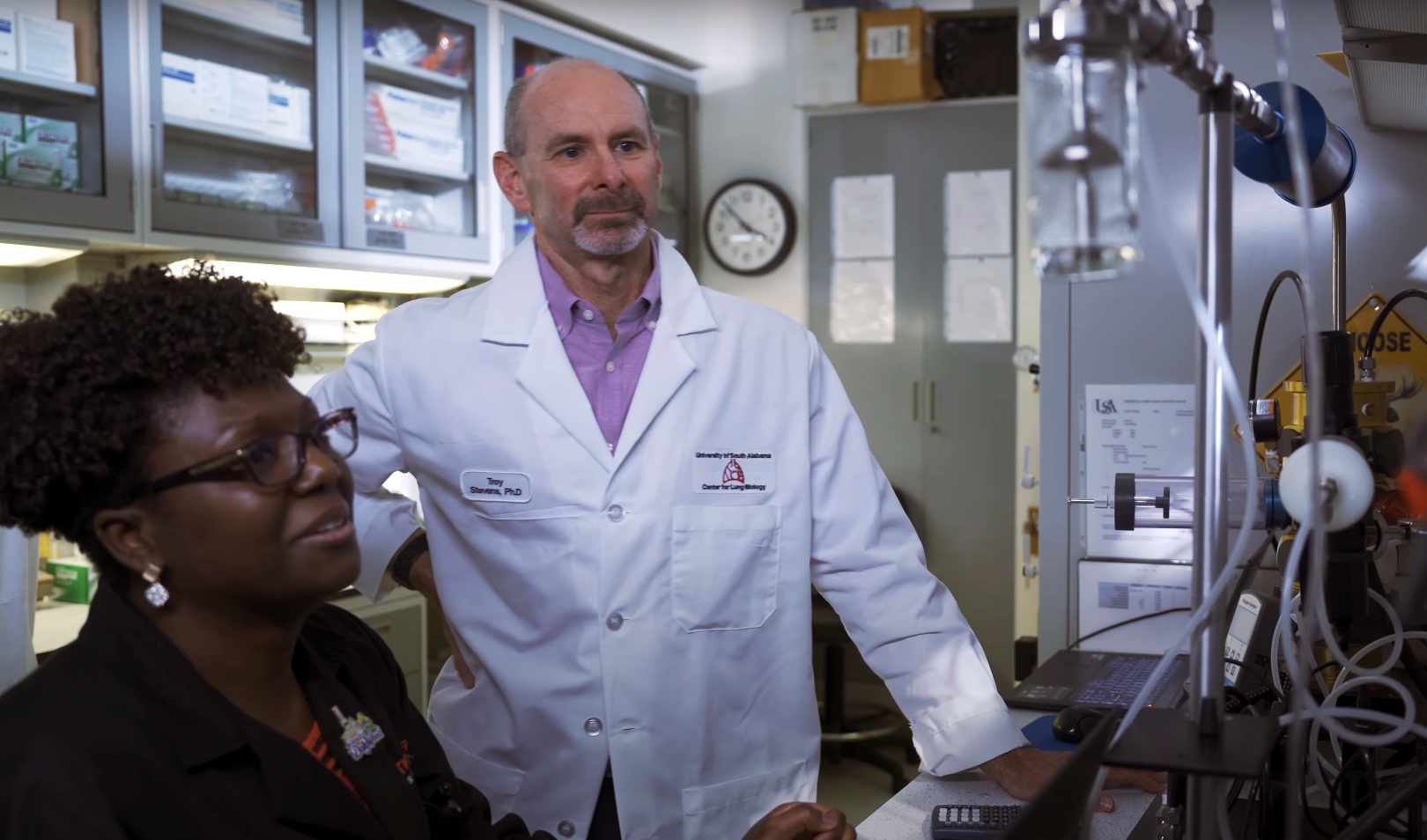
Troy Stevens, Ph.D., professor and Lenoir Louise Locke Chair of Physiology and Cell Biology at the Frederick P. Whiddon College of Medicine and director of the USA Center for Lung Biology; and Dhananjay T. Tambe, Ph.D., associate professor of mechanical, aerospace and biomedical engineering and a member of the Center for Lung Biology, are leading the research.
The project, titled “Pulmonary Artery Endothelial Cell Endotypes and the Role of Anoikis Resistance in Pulmonary Hypertension,” is being conducted in collaboration with colleagues at Brown University in Providence, Rhode Island. Together, the teams are exploring a new approach that could help physicians better diagnose, monitor and treat patients with this life-threatening condition.
Pulmonary hypertension, a disease marked by high blood pressure in the arteries of the lungs, is typically diagnosed through a right heart catheterization. In this procedure, a catheter is advanced through the right ventricle and into the pulmonary artery, allowing physicians to measure blood flow and pressures.
“It turns out,” Stevens explained, “that when you retrieve the catheter, it has cells from the vessel wall on it. These cells can be expanded in a culture dish and their molecular signatures and function assessed.”
By analyzing these patient-derived cells, researchers hope to gain novel insights into the nature of each patient’s disease, their hemodynamic status, and how they may respond to therapy.
“We are characterizing these cells and assessing just how informative they are in helping us understand the patient’s functional status,” Stevens said. “I think it will be very insightful as we move forward.”
The clinical team at Brown University is directing the patient-focused portion of the study. At USA, Stevens, Tambe, and research technicians Linn Ayers and Lauren Jackson are conducting the cell biology investigations.
The findings from this work could pave the way for improved diagnostic tools and personalized treatments for pulmonary hypertension, offering new hope for patients facing a disease that often carries a poor prognosis.
Stevens earned a Ph.D. in physiology from Colorado State University in Fort Collins, Colorado. He completed post-doctoral research in respiratory physiology at the University of Colorado Health Sciences Center in Denver. He joined the faculty at USA in 1996 and became the founding director of the USA Center for Lung Biology in 2002.
Tambe earned a Ph.D. at Brown University and completed post-doctoral training at the Harvard School of Public Health. He joined the faculty at USA in 2014. The Stevens and Tambe labs have worked together to study lung endothelial cell function in health and disease for several years.
About the Frederick P. Whiddon College of Medicine
The Frederick P. Whiddon College of Medicine at the University of South Alabama, the Flagship of the Gulf Coast, was established in 1973. The College of Medicine is a member of the Association of American Medical Colleges and offers two degree programs: the M.D. program and the Ph.D. program in Basic Medical Sciences. USA Health residency and fellowship programs are affiliated with the College and are accredited by the Accreditation Council for Graduate Medical Education.
Photo: Troy Stevens, Ph.D., professor and chair of physiology and cell biology at the University of South Alabama Frederick P. Whiddon College of Medicine, is principal investigator of the NIH-funded research project.




Stay Connected
Fill out and submit the form below to get regular updates from Mobile Chamber delivered directly to your inbox.