
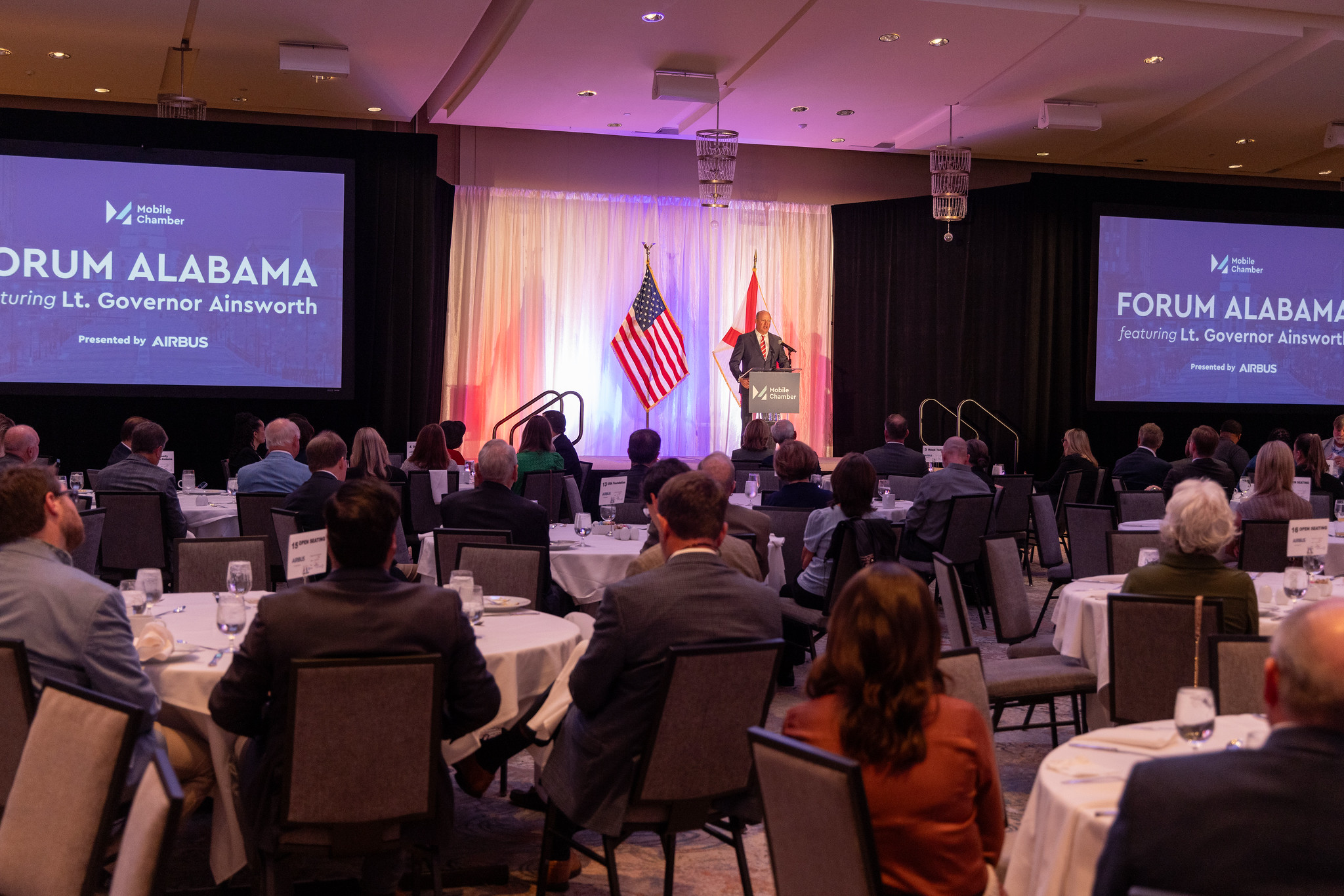
7 Things Lt. Gov. Will Ainsworth Wants Mobile’s Business Community to Know
With his time as Alabama’s lieutenant governor winding down, Will Ainsworth used his appearance at the Mobile Chamber’s Forum Alabama to reflect on the state’s progress and highlight the issues he believes will shape its continued growth — from infrastructure and workforce development to education, aerospace and military support.
Before beginning his prepared remarks, Ainsworth congratulated local leaders on the progress of the I-10 Mobile River Bridge and Bayway project and recognized former Mobile Mayor Sandy Stimpson for his role in pushing the project forward.
With a groundbreaking approaching and construction moving ahead, the long-discussed bridge provided a fitting backdrop for one of the major themes of Ainsworth’s remarks: growth requires infrastructure to support it.
Here are seven takeaways from his Forum Alabama address.
1. Mobile has Ainsworth’s attention and he’s bullish on its future.
Ainsworth opened by emphasizing the economic activity underway in the Mobile area, pointing to major industrial investments, new jobs and continued growth along the Alabama Gulf Coast.
He told the crowd he is “very bullish on what’s going on here because of people in this room” and later called the area “one of the best places, not just in the state, but America.”
Ainsworth said his time as lieutenant governor provided an opportunity to better understand the region and its economic importance.
“What you’re doing from a growth standpoint is amazing,” he said.
2. Infrastructure has to keep pace with growth.
Transportation infrastructure remained one of Ainsworth’s biggest themes.
He reiterated his support for the I-10 Mobile River Bridge and Bayway project, calling it a critical statewide infrastructure priority, while also pointing to the need for improvements along Interstate 65.
“For so long, if anybody knows me for one thing, I-65, right?” he said. “But if you ever listen to me talk, I said the number one infrastructure project in our state, you’ve got to get I-10 done first.”
For coastal Alabama, he said that means continuing to advocate for the region’s share of infrastructure investment as economic activity increases.
“If we don’t have the infrastructure, it’ll stop growth,” he said.
3. He believes Alabama is in its strongest fiscal position yet.
Ainsworth told the audience Alabama remains in what he described as the best fiscal shape he has seen during his time in state government.
He pointed to growth in the Education Trust Fund and said the state has accumulated approximately $2.4 billion across reserve accounts.
That financial cushion, he said, gives Alabama more flexibility if the economy enters a downturn or if leaders need to make additional investments in areas such as education and workforce development.
Ainsworth contrasted the current environment with the financial challenges facing the state when he entered the Alabama House in 2014.
“The state is in solid financial shape,” he said.
4. Education reform and giving families more choices remain a priority.
Ainsworth highlighted Alabama’s recent improvement in math and reading scores as one of the areas he is most proud of, crediting Gov. Kay Ivey and the Alabama Legislature for their work on education.
He told the audience Alabama moved from last to 34th in fourth-grade math and from 49th to 34th in reading.
Ainsworth also spent time discussing school choice and the expansion of education options available to Alabama families.
“We believe parents deserve and know what’s best for their child,” he said.
He said families should have access to a range of options, including traditional public schools, charter schools, specialized schools, homeschooling and private schools.
At the same time, Ainsworth stressed that school choice should not come at the expense of public education.
“We’ve got to have vibrant public schools,” he said, while adding that the state should also strive for strong charter, specialized and private schools.
5. Solving Alabama’s workforce challenge requires more than one pipeline.
Ainsworth said workforce development remains a major focus for Alabama and requires coordination across high schools, community colleges, universities and employers.
“It’s not just one piece of the puzzle,” he said. “You’ve got to have them all clicking in.”
Among the initiatives he highlighted was Alabama’s workforce diploma, aimed at helping high school students who do not plan to pursue a traditional college pathway begin learning a skilled trade before graduation.
He also pointed to the creation of a cabinet-level workforce position and described Secretary of Workforce Greg Reed as someone employers can turn to when they need help solving workforce challenges.
Ainsworth also highlighted childcare and housing as workforce issues.
He said Alabama’s childcare tax credit can help remove barriers for families who want to participate in the workforce and pointed to the workforce housing tax credit as particularly important in growing areas of the state, including the coast.
6. Mobile’s aerospace growth creates an opportunity to recruit talent from all 67 counties.
Ainsworth called Alabama “the aerospace capital of the world” and specifically pointed to Airbus’ presence in Mobile as a major part of the state’s aerospace industry.
But his workforce message extended well beyond the coast.
Ainsworth said Alabama should take a “67-county approach” to building the aerospace talent pipeline, making sure students throughout the state understand the career opportunities available in Mobile and the quality of life the area offers.
He specifically referenced students in his home region of Marshall County, saying they should know about the opportunities available on the coast.
Ainsworth also highlighted the creation of a new Alabama Aerospace and Defense Council, with Airbus among its founding members, and said one of its primary goals is growing the talent pipeline and increasing awareness of aerospace careers across Alabama.
7. He plans to “run through the tape” and stay involved after leaving office.
As Ainsworth approaches the end of his time as lieutenant governor, he devoted part of his closing remarks to the work he is most proud of.
That included Alabama’s efforts to support military installations, veterans, active-duty service members and military families through the Alabama Military Stability Commission.
Ainsworth said more than 70 bills have been passed through that effort since 2018 and described the work as one of the greatest honors of his time in office.
He also made clear that leaving statewide office will not mean stepping away entirely from issues affecting Alabama.
Ainsworth said he plans to launch a group called Moving Alabama Forward that will continue working on issues including workforce and education.
For now, however, he said his attention remains on finishing his term.
“I’ve got three and a half months left,” Ainsworth said. “I’m going to work hard. I’m going to run through the tape.”
He ended where he began, with a strong assessment of coastal Alabama and the people driving its economy.
“I love our state. I love the people, and I’m extremely bullish on this area,” he said. “And I just want to thank everybody for the honor of being able to serve as Lieutenant Governor.”




Stay Connected
Fill out and submit the form below to get regular updates from Mobile Chamber delivered directly to your inbox.