
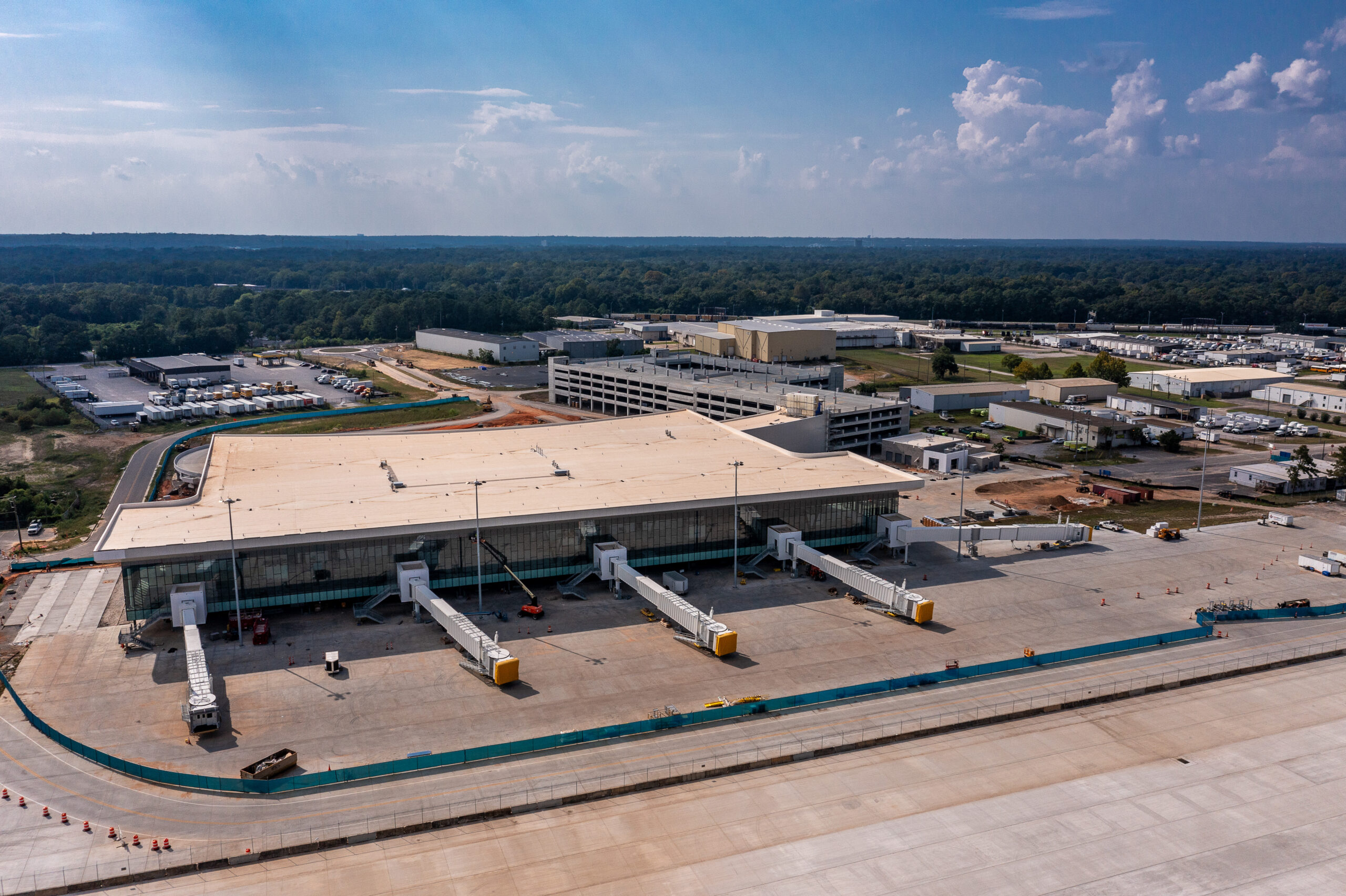
5 Things We Learned About Mobile’s New Airport in Downtown
Mobile Airport Authority Chairman Sandy Stimpson recently joined the Mobile Chamber’s Executive Roundtable to give business leaders a closer look at Mobile International Airport, the new airport in downtown Mobile, where the project stands and what comes next.
His update went well beyond construction progress, offering insight into the opening timeline, future air service, airline recruitment and the role local businesses can play in the airport’s success. Here are five things we learned.
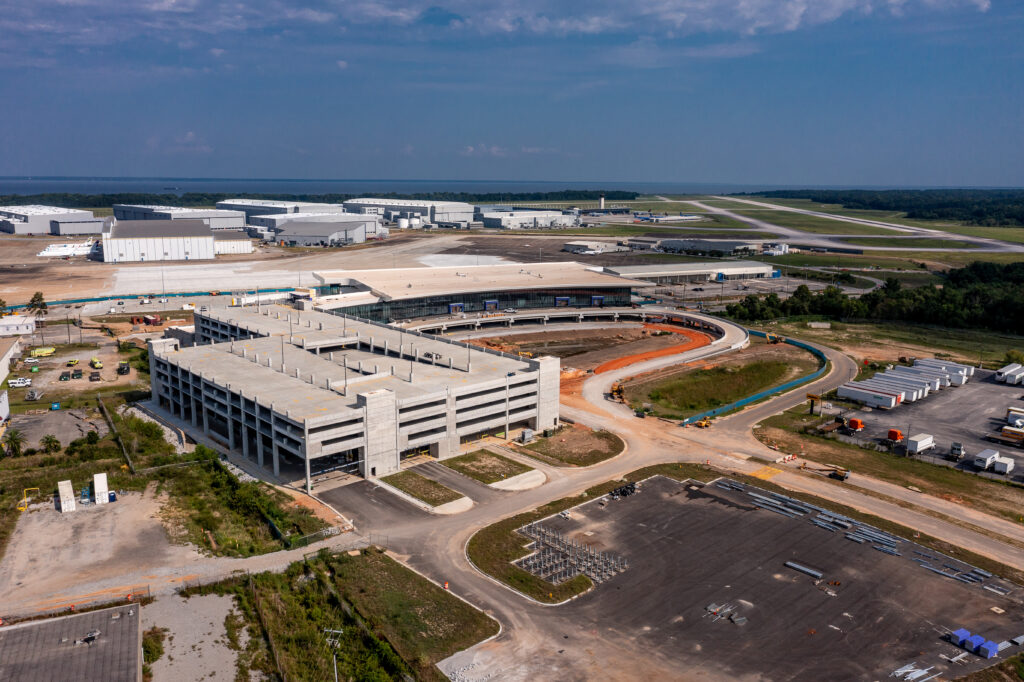
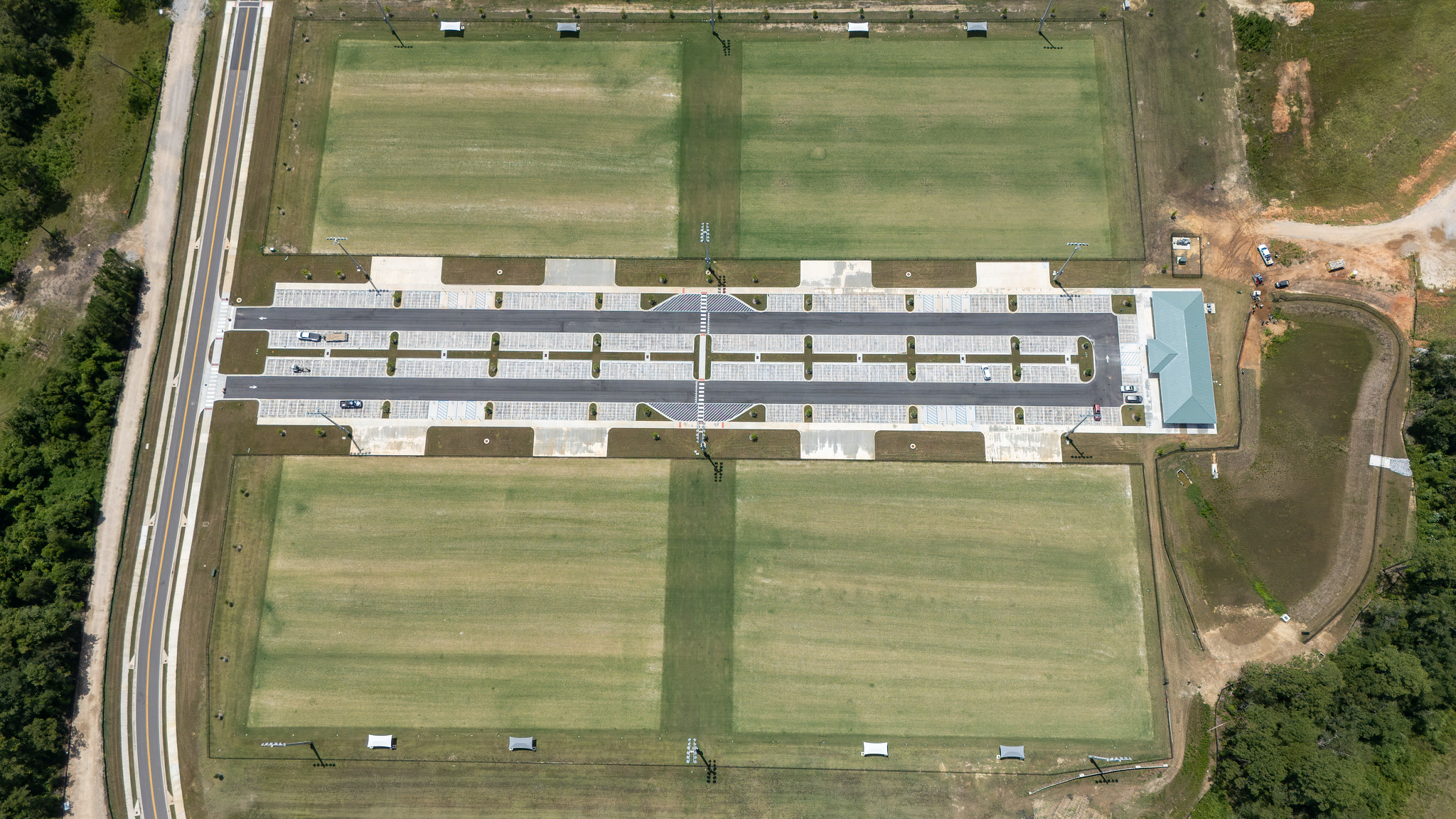
Mobile International Terminal Site Construction Aerials
The airport is targeting a 2027 opening.
The transition of commercial air service from Mobile Regional Airport to the downtown airport is expected in 2027, with project leaders currently working toward a goal of late spring.
An exact opening date has not yet been announced. That is intentional. With a project this complex, officials want to be confident the date can be met before putting it on the calendar.
The transition itself will also be significant. Rather than gradually moving flights from one airport to the other, the plan is for commercial service to transition from Mobile Regional to the downtown airport at once.
Teams specializing in Operational Readiness, Activation and Transition, or ORAT, are working through everything from airline and rental car computer systems to baggage equipment, employee training and passenger logistics to make that transition possible.
Convenience is one of the biggest reasons for the move.
The decision to move commercial air service downtown was never simply about building a new terminal. It was about putting Mobile’s commercial airport closer to the center of the region it serves.
For years, Mobile has experienced passenger “leakage,” with travelers choosing neighboring airports instead of flying from Mobile.
The downtown location significantly changes the equation.
For travelers coming from downtown Mobile, Baldwin County, Mississippi and other parts of the region, the new airport will offer much easier access from Interstate 10. The goal is to make flying from Mobile more convenient for a much larger share of the regional population and to recapture travelers who have been driving elsewhere to catch a flight.
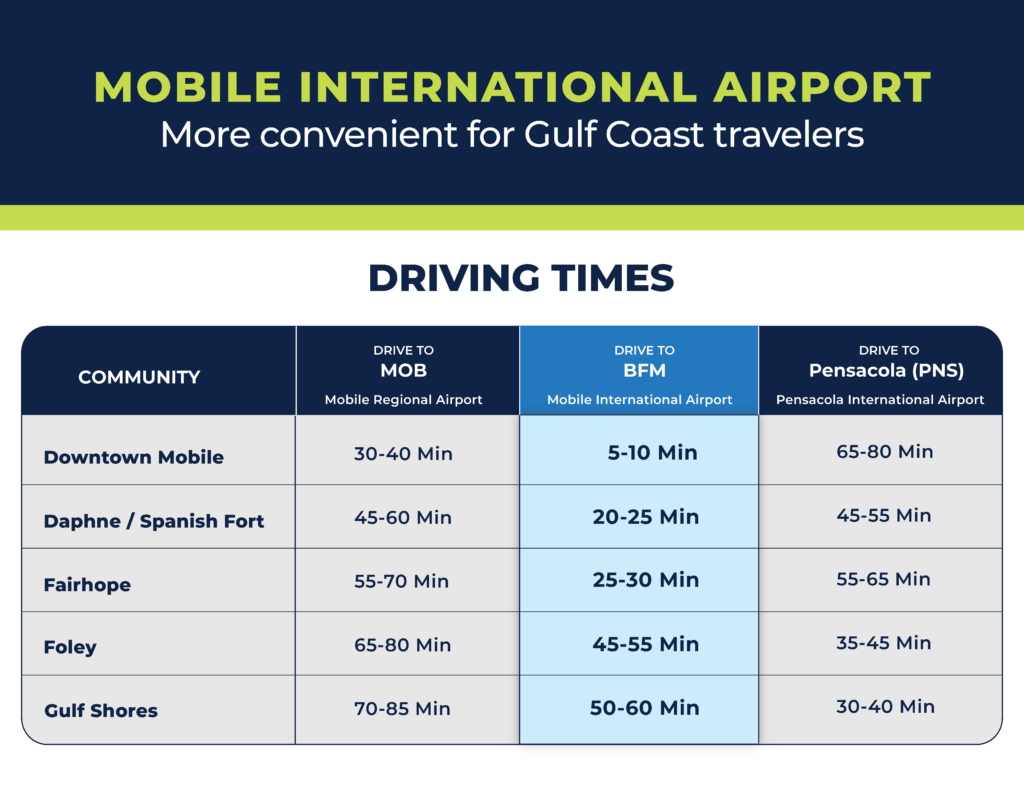
Mobile International Airport Driving Times
The terminal is being built with growth in mind.
The first phase will include five gates, but the terminal was designed to expand as passenger demand grows.
Future expansion could bring the terminal to 12 gates, with additional capacity available through the existing low-cost terminal nearby.
Parking is being planned with the same approach. The airport will open with a five-story parking garage containing 1,250 spaces along with additional surface parking, creating roughly 1,600 spaces overall.
Inside, passengers will move directly between the parking garage and terminal, and planners are working to create a distinctly Mobile “sense of place” throughout the facility.
The goal is not simply to build for opening day, but to create an airport that can grow with Mobile.
Better air service will depend on making a strong business case to airlines.
The destinations Mobile travelers want are no secret.
New York, Chicago and Denver were identified among the most requested destinations, with cities including Miami, Orlando and Nashville part of the broader conversation.
But adding a nonstop flight is not as simple as asking an airline for one.
Airlines make route decisions based heavily on data. Mobile must demonstrate that enough passengers will consistently use a new route to make it more profitable than other opportunities competing for the same aircraft and gates.
Growth can take several forms, including larger aircraft, increased frequency on existing routes, additional nonstop destinations and, ultimately, the potential to attract additional carriers.
Another major factor is the airport’s cost per enplanement; a metric airlines use when evaluating the cost of serving an airport. Keeping that cost competitive could make Mobile more attractive, particularly to low-cost carriers.
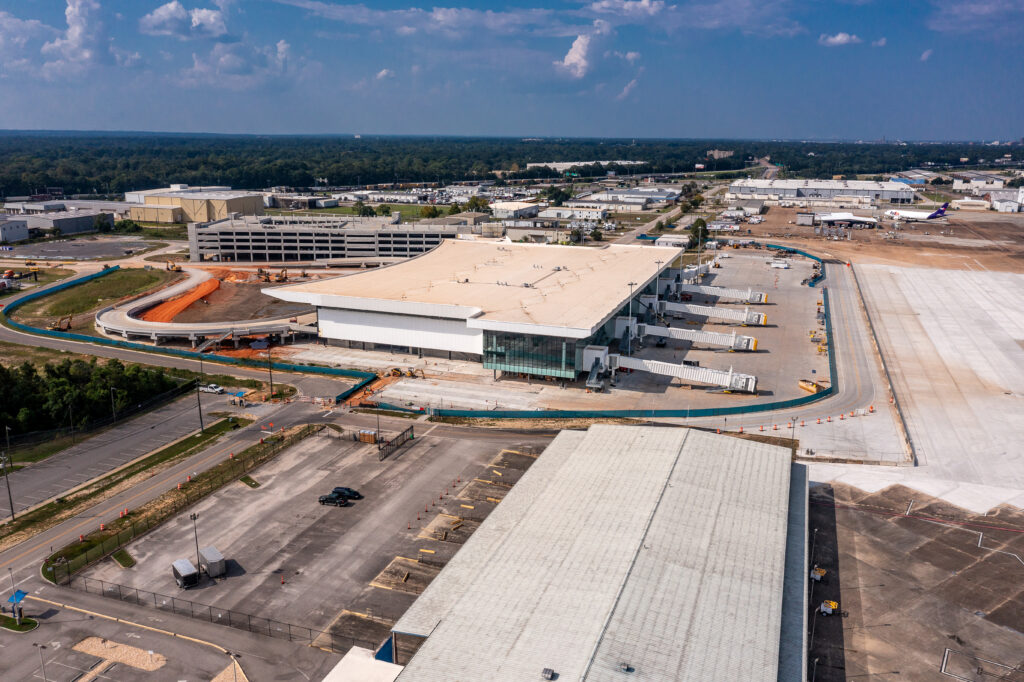
Mobile International Terminal Site Construction Aerials
The business community can directly influence what happens next.
Perhaps the most important takeaway had nothing to do with concrete, gates or parking garages.
Flights follow demand.
A more convenient airport gives Mobile an opportunity to change its air service story, but airlines will ultimately watch what travelers actually do.
That is where Mobile-area businesses and leisure travelers come in.
As more passengers choose to begin their trips in Mobile, airport leaders gain stronger data to take into conversations with airlines about additional flights, larger aircraft, new nonstop destinations and new carriers.
“Every time a business traveler chooses to fly from Mobile, it helps demonstrate the strength of our market,” said Mobile Chamber President and CEO Designate David Rodgers. “We want our business community to take advantage of the convenience this new airport will offer and choose Mobile. The more passengers we have flying from here, the stronger the case we can make for expanded air service in the future.”
Our Next Step: Fly Mobile
A new airport can create the opportunity for better air service. Using it is how we make that opportunity real.
Every passenger matters. Every company that shifts its travel back to Mobile strengthens the data airport officials can take to airlines when making the case for larger aircraft, additional frequencies, new nonstop destinations and new carriers.
We have spent years asking for better air service.
Now, as the new airport prepares to open, the business community has an opportunity to help create it.
Commit to fly Mobile. Because the more we use our airport, the stronger the case becomes for airlines to invest in our market.


Stay Connected
Fill out and submit the form below to get regular updates from Mobile Chamber delivered directly to your inbox.